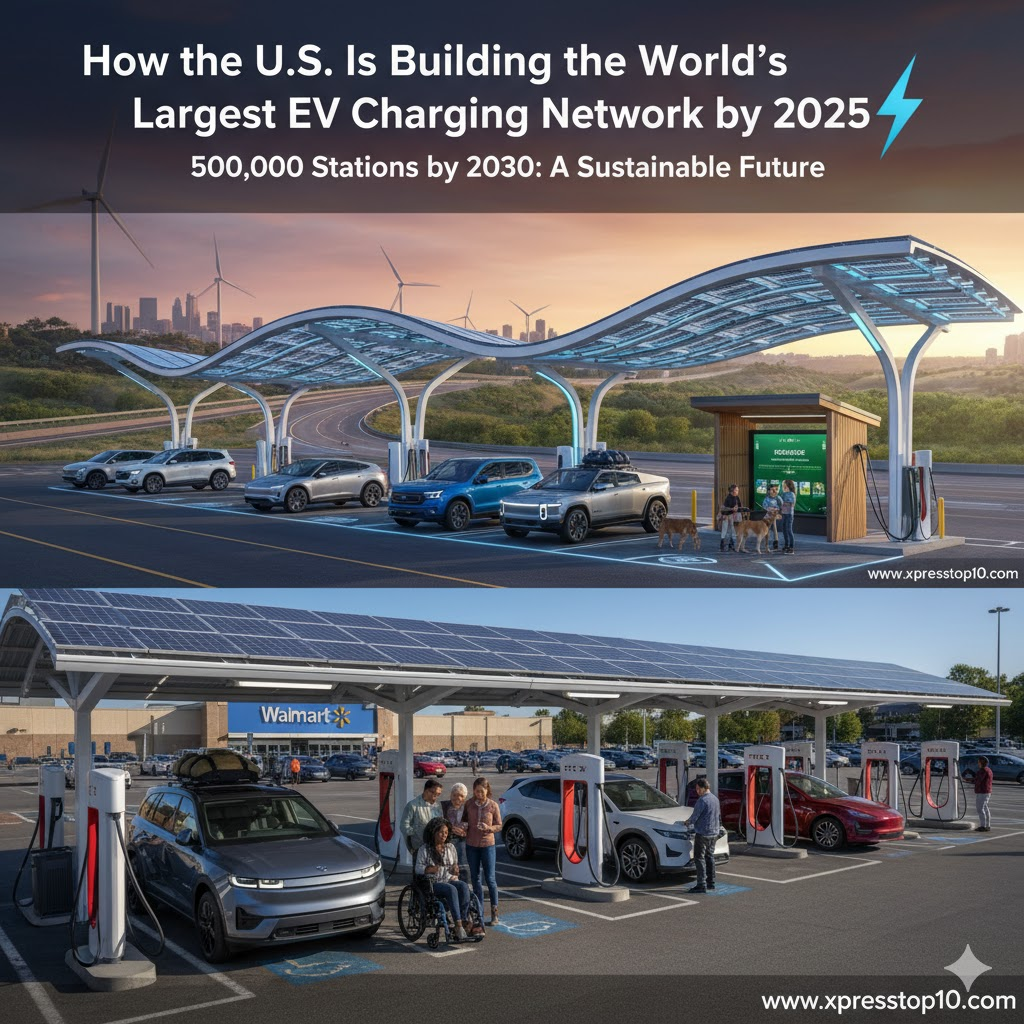
When you think of the electric vehicle (EV) revolution, sleek Teslas and futuristic Rivians probably come to mind first. But behind every EV on the road lies something far more important — the charging network. And in 2025, the U.S. is quietly (and quickly) building one of the largest and most advanced EV charging infrastructures in the world.
As the country races toward a cleaner, more sustainable future, the expansion of EV charging stations has become one of the most critical parts of America’s green transformation. Let’s dive deep into how this network is shaping up, what it means for drivers, and how it stacks up globally.
⚡ How Many EV Charging Stations Are in the U.S. in 2025?
As of 2025, the United States has over 180,000 public EV charging ports, spread across more than 70,000 charging station locations. This number represents an impressive growth of nearly 60% from 2023, thanks to federal initiatives like the National Electric Vehicle Infrastructure (NEVI) Formula Program and private sector investment from giants like Tesla, Electrify America, and ChargePoint.
California continues to lead the charge — with nearly 30% of all U.S. chargers — followed by states like New York, Texas, and Florida. But smaller states aren’t being left behind; federal funding ensures every state builds at least a few thousand chargers by the end of 2025, creating a truly national network.
🏗️ The Vision: 500,000 Charging Stations by 2030
The Biden Administration has set an ambitious goal — to develop 500,000 public EV charging stations by 2030. This goal isn’t just about convenience; it’s about confidence. One of the biggest barriers to EV adoption is “range anxiety” — the fear of running out of charge mid-journey.
To tackle this, the government’s NEVI program allocates $5 billion in funding over five years to states to build chargers every 50 miles along major highways. The plan aims to make cross-country EV travel as easy as stopping for gas.
(For official NEVI details, check the U.S. Department of Transportation’s Federal Highway Administration site.)
🔌 The Largest EV Charging Networks in the U.S.
When it comes to sheer size and reliability, several networks are dominating the EV landscape:
1. Tesla Supercharger Network
Tesla continues to lead with over 25,000 fast chargers across the U.S. By 2025, these Superchargers are no longer exclusive — thanks to Tesla opening its network to non-Tesla vehicles, a move encouraged by federal funding requirements. Drivers using adapters can now charge Fords, Rivians, and even Hyundai EVs at Tesla stations.
2. Electrify America
Funded by Volkswagen’s “Dieselgate” settlement, Electrify America operates more than 5,000 ultra-fast chargers in 47 states. It’s expanding rapidly with a focus on interstate routes and major retail locations like Walmart and Target.
3. ChargePoint
A pioneer in EV charging, ChargePoint has built over 35,000 charging locations with both Level 2 and DC fast chargers. Unlike Tesla or Electrify America, ChargePoint’s model focuses on flexibility, allowing businesses, offices, and cities to own and operate their own stations through its network.
4. EVgo
EVgo runs one of the largest public fast-charging networks powered entirely by renewable energy. With around 1,500 locations, it’s working with GM, Nissan, and Uber to make charging faster and more accessible for fleet vehicles.
🚗 What Percentage of U.S. Cars Will Be Electric by 2025?
In 2025, about 12% of all new cars sold in the U.S. will be electric, up from just 6% in 2023. That translates to roughly 2 million EVs expected to hit American roads this year alone.
This rapid adoption is fueled by:
- More affordable EV options from brands like Ford, Hyundai, and Toyota.
- Tax credits up to $7,500 for new EV purchases under the Inflation Reduction Act.
- And, of course, a more reliable charging infrastructure making EV ownership practical for everyday Americans.
By 2030, experts predict that one in three cars sold in the U.S. will be electric.
🌎 How the U.S. Compares Globally in EV Infrastructure
When comparing the U.S. to other countries, it’s still playing catch-up to China and parts of Europe.
- China has over 2 million public chargers, leading the world by far.
- Europe, led by countries like Norway, Germany, and the Netherlands, follows with nearly 500,000 chargers.
- The U.S. ranks third, but with its 2030 roadmap and private-sector partnerships, it’s quickly narrowing the gap.
What’s unique about the American model is its collaboration between government and corporations, ensuring the charging grid grows efficiently without becoming monopolized by any one player.
💼 Why Countries Are Investing Heavily in EV Infrastructure
It’s not just about cars — it’s about climate, jobs, and technology.
For the U.S., investing in EV charging means:
- Cutting emissions: Transportation accounts for roughly 29% of U.S. greenhouse gas emissions.
- Creating jobs: Every charging site brings electricians, engineers, and software specialists into the workforce.
- Boosting the economy: The EV charging market size in the U.S. is projected to surpass $25 billion by 2030, according to BloombergNEF.
Globally, countries see EV infrastructure as a way to future-proof their economies, reduce oil dependency, and accelerate renewable energy use.
🔍 EV Charger Market Share by Company (2025 Snapshot)
| Company | Market Share (%) | Notable Strength |
|---|---|---|
| Tesla | 33% | Fast, reliable, expanding to non-Tesla vehicles |
| ChargePoint | 24% | Flexible and business-friendly |
| Electrify America | 18% | Nationwide coverage & ultra-fast chargers |
| EVgo | 10% | 100% renewable-powered |
| Others | 15% | Includes Blink, Shell Recharge, Volta, etc. |
EV Charger Market Share by Company
🔋 The Future: Smart Charging and Renewable Integration
By late 2025, EV charging won’t just be about plugging in — it’ll be intelligent.
- Smart grids will balance electricity demand by charging cars during off-peak hours.
- Solar-powered stations will reduce energy costs and dependence on the main grid.
- Vehicle-to-Grid (V2G) systems will allow EVs to send power back to the grid — turning every parked car into a mini power plant.
Imagine charging your car while it also helps power your home — that’s not sci-fi anymore; it’s happening in pilot programs across California and Texas.
🌱 Final Thoughts: The Road to 2025 and Beyond
The EV revolution isn’t just about electric motors — it’s about infrastructure, innovation, and imagination. The U.S. may have started late compared to some nations, but in 2025, it’s moving faster than ever before.
Every new charging station isn’t just a place to refuel — it’s a symbol of progress, a quiet statement that the world is shifting gears toward sustainability. And with 2030’s 500,000-charger goal in sight, the U.S. is on track to lead the next era of green mobility.
External Sources for Further Reading:
- U.S. Department of Energy – Alternative Fuels Data Center
- Electrify America Official Network Map
- Tesla Supercharger Expansion Update 2025
- BloombergNEF EV Charging Report 2025
Ending Keywords: EV charging infrastructure, U.S. EV network, Tesla Supercharger, EVgo, Electrify America, EV charger market share, future of EVs 2025, renewable energy charging, NEVI program, electric vehicle growth.