
A few months ago, I was walking through downtown Denver on a quiet Sunday morning. The sun was barely up, the streets were calm, and yet the sidewalks were already awake — lights shifting gently as people passed by, trash cans humming softly as they compacted waste, bus stops displaying live updates before the buses even arrived.
It didn’t feel futuristic. It felt… thoughtful.
Like the city had finally learned how to pay attention.
Across the country in 2025, this is becoming the new normal. Public spaces—parks, transit hubs, riverwalks, open squares—are being redesigned not just to look better, but to behave better. And as Americans search more about “Agenda 2030 smart cities list,” “Smart City 2025,” “U.S. smart city projects,” and even “Smart cities 2030 map,” it’s clear people are curious about what’s actually changing.
What’s happening isn’t a grand overnight transformation. It’s a steady layering of small improvements that make daily life a little smoother, a bit cooler (literally, in heat-prone states), and definitely more connected.
Table of Contents
🌿 Why Cities Are Rethinking Public Spaces Right Now
Most city planners I’ve spoken to lately echo the same thing: people don’t just want big infrastructure; they want comfortable, usable public places.
And honestly, it makes sense:
- Cities are more crowded.
- Weather is harsher.
- Technology is cheaper.
- People want cleaner, greener spaces.
Public areas—once treated like leftovers between buildings—are back in the spotlight.
A smart park today may have shaded seating that charges your phone, walkways made from heat-reflective materials, or benches that glow softly at night. A smart plaza might show real-time transit updates, pollution levels, or emergency alerts. These aren’t just upgrades; they’re signals that cities want to meet people where they are.
🌆 What Smart Public Spaces Look Like in 2025
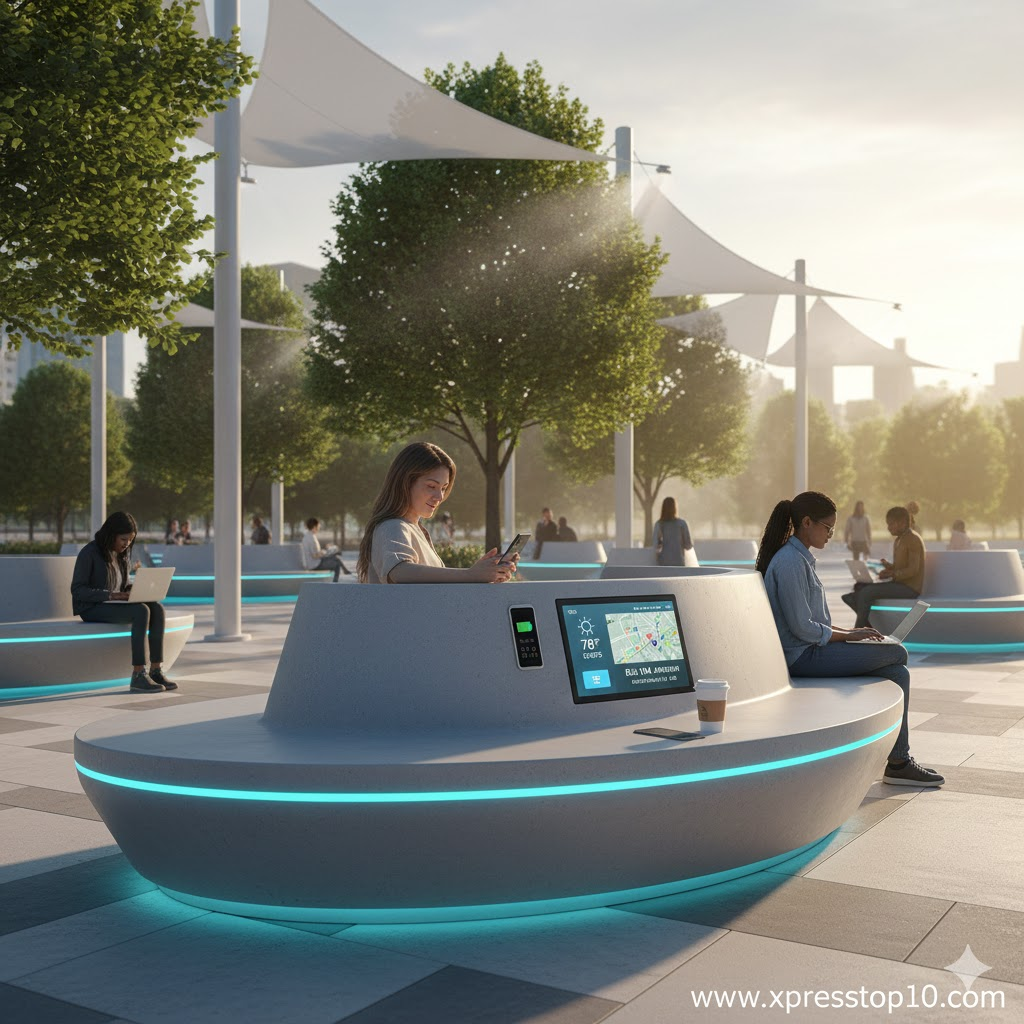
Instead of listing features like a brochure, here’s what it feels like:
You walk under streetlights that brighten as you pass.
Chicago and Phoenix have invested in intelligent lighting that responds to movement instead of staying on full blast all night. It saves energy and somehow makes late-night walks feel safer.
You sit at a park bench and end up learning something.
In Boston, Seattle, and other “quietly smart” cities, digital kiosks now share everything from local events to the next bus arrival. They’ve become a modern version of neighborhood notice boards.
Your phone connects to free Wi-Fi in places that once felt ignored.
Many U.S. cities are trying to close the digital gap, turning parks and public squares into Wi-Fi zones so people can work, study, or simply connect outdoors.
Trash cans that never overflow anymore.
It sounds small, but it’s huge. New York and Philadelphia use “smart bins” that compact trash and alert the city when they’re full. Cleaner sidewalks, fewer rodents, happier residents.
Heat-ready spaces appearing in hot states.
If you’ve ever spent a summer in Phoenix, Dallas, or Vegas, you know shade is more valuable than gold. Cities now invest in misting poles, shaded bus stops, and cool pavements that reduce surface heat.
These changes aren’t loud or attention-seeking. They’re practical. And they’re slowly becoming the norm.
🗽 The U.S. Cities Leading the Smart Space Transformation

People keep searching for “List of smart cities in America” or “Smart City 2025 list,” so here’s a realistic picture—not marketing fluff, just cities that are genuinely doing the work.
Cities Way Ahead:
- New York City, NY – Smart kiosks, energy-efficient parks, and AI-optimized traffic.
- Chicago, IL – One of the largest smart streetlight networks in the country.
- Seattle, WA – Green infrastructure everywhere—rain gardens, eco-walkways, public dashboards.
- Austin, TX – Heat-resistant public spaces and modern transit redesigns.
- Boston, MA – Climate-ready waterfronts and smart pathways.
- San Francisco, CA – Micro-mobility hubs and autonomous shuttles in limited zones.
- Phoenix, AZ – Cooling corridors, shade-heavy parks, and reflective materials.
Cities Gaining Momentum:
- Miami, FL
- Minneapolis, MN
- Charlotte, NC
- Orlando, FL
- Columbus, OH
- Atlanta, GA
These are the places likely to define the “Smart Cities 2028–2030 list” that people keep searching for.
🏞 Real Examples You Can Actually See
Here are a few real-world projects that feel different when you’re standing in them:
New York’s modernized High Line
More shade, more plants, better lighting, and sensors to monitor crowd flow. It feels more alive than ever.
Los Angeles’ upgraded bus shelters
Solar panels on top, air-quality displays, and cooling features—perfect for hot days.
Phoenix’s “cool corridors”
I walked through one recently, and yes, you can feel the difference. Shade + smart materials = better walks.
Boston’s resilient waterfront
Part park, part climate shield. A beautiful example of design meeting necessity.
Columbus’ smart mobility hub
Screens showing everything from bus arrivals to EV charger availability—it’s surprisingly helpful.
These aren’t prototypes; they’re open to the public.
🌍 The Agenda 2030 Connection (Without the Buzzwords)

People often ask if American cities are “following Agenda 2030.”
Not directly. But many elements—sustainable energy, smarter infrastructure, public inclusivity—overlap naturally with what cities already need.
If you want to explore the official goals, the UN link is here:
🔗 https://sdgs.un.org/goals
But you don’t need to understand all 17 goals to see the impact.
Just walk through any revitalized U.S. downtown area. It’s happening.
🚶 How Smart Public Spaces Change Daily Life
Here’s the real impact—beyond the fancy tech:
- You feel safer at night because lighting adapts to movement.
- Kids play in cooler parks because cities now design with heat in mind.
- People talk more because shaded seating and Wi-Fi bring them out of their homes.
- Commuters relax because bus stops feel like shelters, not punishment.
- Cities save money, and those savings go back into public services.
These are the quiet upgrades that improve life without anyone posting about them on social media.
🔮 What Smart Spaces Might Look Like By 2030
If current trends continue, cities could be heading toward:
- Streets that guide visually impaired pedestrians
- Parks powered entirely by renewable energy
- Seating that senses weather and adjusts shading
- Screens that give real-time updates during emergencies
- Electric, driverless shuttles linking public areas
- Cooling networks beneath walkways
It won’t be sci-fi.
It’ll just be… normal.
⭐ Final Thoughts
The smartest cities in America aren’t the ones with the most technology.
They’re the ones paying attention to the small things — heat, shade, safety, accessibility, and how people actually use shared spaces.